Blue Collar
Two moments made me think deeply about so-called “blue collar” workers this week.
The first was the chart that Anthropic put out, attempting to quantify the potential risk from AI to various job roles:
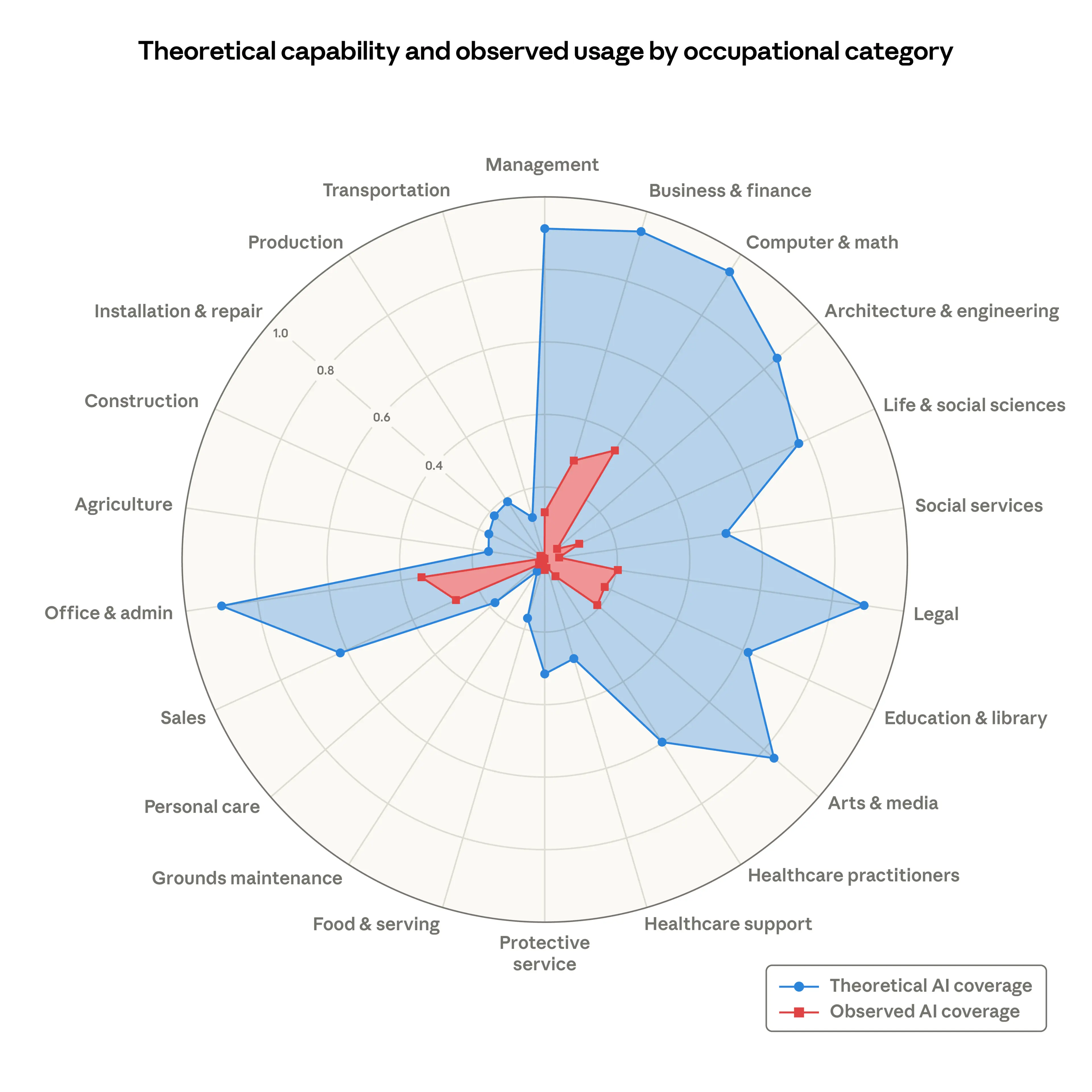
Source: Anthropic
It's instantly apparent what the core answer is here: effectively all white collar jobs are under threat, whilst manual labour is relatively immune - at least before embodied AI (i.e. robotics) begins to hit maturity.
The second was a pitch from an entrepreneur building AI-native vertical software for tradespeople. The idea is that a lot of tradespeople’s time is taken up by administrative hassle that doesn’t take advantage of their skills, and by outsourcing that to a software stack, the tradesperson can generate more revenue and increase their productivity.
A few disparate thoughts are percolating in my head.
First, there’s a hilarious irony that it’s mostly white collar investors who are currently pouring hundreds of billions of dollars at paying mostly blue collar construction professionals to build the AI data centres that have the potential to displace those same white collar jobs in future. Maybe turkeys do vote for Christmas, after all...
Second, it’s clear that the historical neglect and disparagement of skilled tradespeople (in favour of academic paths) is now biting us in the arse because we lack sufficient capacity of skilled workers to alleviate the limiting factor of AI rollout: namely, data centres. Again, there's a beautiful irony that the nerds obsessed with arranging bits are held back by the lack of people to help arrange atoms.
Third, the risk/reward of a blue collar vs a white collar career path looks completely upside down vs what we’ve been taught in the past 50 years. Being a banker, or a lawyer, or an accountant, or a consultant, might be one of the most fragile places to be right now. By contrast, the guy or girl with the wrench and the hammer is getting more customer calls than they can handle.
Finally, we may be about to hit an insane productivity paradox where constraints are alleviated for some portion of the workforce, by technology, whilst economic viability is completely destroyed for another portion of the workforce. It's hard to think of a precedent example where extreme opposite outcomes are triggered by the same underlying technology event.
These are unusual times.